This is the reseller playbook for turning a white-label CRM into a product agencies actually own. Below, the 6 white-label CRM platforms most agencies weigh in 2026, then the 5-step process I use to brand and resell one.
Selling a white-label CRM is one of the easier B2B offers I've ever launched. Here's the structure I use, and the 3 things that make it work.
The 6 white-label CRM platforms for agencies compared (2026)
Before you pick a platform, the real question is whether you want to own the code or rent access to someone else's. Here are the 6 white-label CRM options most agencies weigh, split by which side of that line they sit on.
| Platform | Model | Own the source code? | White-label path |
|---|---|---|---|
| Seedly CRM | One-time source purchase | Yes, full source | $1,499 one-time, unlimited sub-accounts |
| SuiteDash | SaaS | No | Add-on white-label plan |
| GoHighLevel | SaaS | No | Agency Pro monthly plan |
| Vendasta | Reseller SaaS | No | Custom-quoted reseller tier |
| Jetpack CRM | WordPress plugin | Plugin source only | Bundled extension license |
| Complete CRM | SaaS | No | Custom-quoted white-label |
- Model
- One-time source purchase
- Own the source code?
- Yes, full source
- White-label path
- $1,499 one-time, unlimited sub-accounts
- Model
- SaaS
- Own the source code?
- No
- White-label path
- Add-on white-label plan
- Model
- SaaS
- Own the source code?
- No
- White-label path
- Agency Pro monthly plan
- Model
- Reseller SaaS
- Own the source code?
- No
- White-label path
- Custom-quoted reseller tier
- Model
- WordPress plugin
- Own the source code?
- Plugin source only
- White-label path
- Bundled extension license
- Model
- SaaS
- Own the source code?
- No
- White-label path
- Custom-quoted white-label
Seedly CRM is the only option in this table where you get the full application source and can rebrand, resell, and modify without a monthly rent to the platform. Best fit if the resale margin is the point of the exercise.
SuiteDash is the incumbent SaaS white-label for agencies that want everything in one place. The white-label upgrade rents you the branding, not the codebase, and the monthly bill scales with your client count.
GoHighLevel is the most feature-complete agency SaaS but the white-label sits on their $497 Agency Pro plan and every feature update ships on their schedule. If GHL is why you're here, the deeper comparison lives in GoHighLevel alternatives where you actually own the code.
Vendasta is the reseller platform play, not a white-label CRM in the strict sense. You get their marketplace of apps rebranded to your logo. Good fit if you sell other people's products for a living.
Jetpack CRM is the WordPress-flavored option and the only one that lets you own the plugin source through an extension license. Reasonable pick for agencies that already sell WordPress builds.
Complete CRM is a longtime SuiteDash competitor with a similar model. Custom pricing and no source ownership.
If resale margin is the reason you're reading this, the code-ownership row is the one that changes your P&L. The rest of this playbook is the process I use when the answer is "yes, I want to own it," starting with why the SaaS version of white-label is a trap.
If you already know you want the owned route and just want the product page, that is Seedly CRM's white-label CRM, which is the platform this playbook is written from.
The SaaS white-label trap
Most SaaS CRMs offer a "white-label" plan that lets you slap your logo on their platform and charge your clients. Sounds great until you realize a few things.
- You're still paying per seat, per sub-account, or per client
- They control the feature set, the update schedule, and the uptime
- Your "white-label" is really just a skin on someone else's product
- If they raise prices, add features you don't want, or shut down, your "product" goes with them
That's not white-labeling. That's being a reseller with extra steps. I break down the full cost difference in What Your CRM Actually Costs Over 5 Years.
Join the Seedly owners community.
Owners trade setups, share add-ons, and swap playbooks. See what people are building before you commit.
Real white-labeling starts with source code
When you own the source code, white-labeling means something completely different. You're not skinning someone else's product. You're building YOUR product from a foundation that already works.
Your styles. Your fonts. Your colors. Yours.
You'll be in control of feature updates. You'll be in control of what and how you charge. You'll get to plug anything into it that you want. You'll get to choose your telephony and email providers. Refactor it and build your own product to resell.
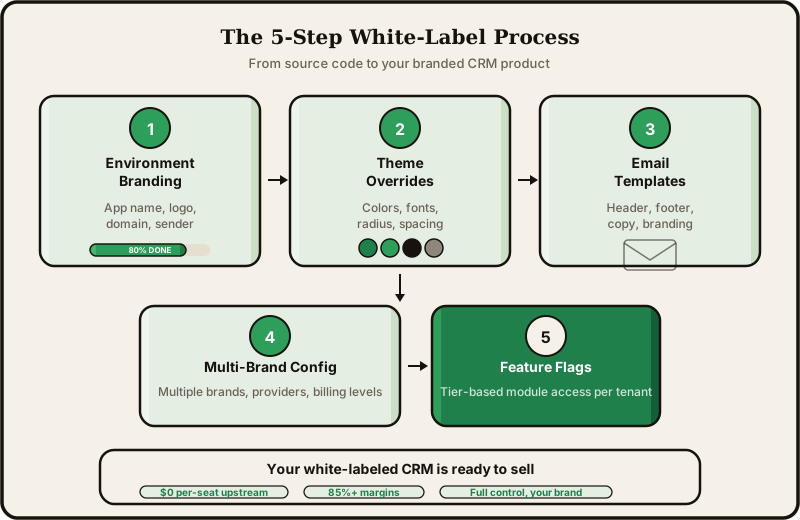
The 5-step white-label process
Step 1 - Environment-based branding
The fastest way to white-label a CRM is through environment variables. Change the app name, primary colors, and domain without touching a line of core code.
Most well-built CRM codebases (including Seedly) let you configure.
- App name and logo
- Primary and accent colors
- Default email sender name and address
- Domain and subdomain routing
This alone gets you 80% of the way to a white-labeled product.
Step 2 - Theme overrides
CSS variables or Tailwind tokens let you completely transform the look without modifying component code. Swap the color palette, change the border radius, adjust the typography, and your CRM looks nothing like the original.
The key is that these overrides don't touch the core. When the underlying codebase gets updates, your theme stays intact.
Step 3 - Email template customization
Every CRM sends email. Welcome emails, notifications, reminders, invoice receipts. Each of these needs to carry your brand, not the original product's.
With source code ownership, you can modify every template. Header logo, footer text, color scheme, copy - all of it. With a SaaS white-label, you're usually limited to whatever template editor they give you.
Step 4 - Multi-brand configuration
Here's where owning the code really pays off. I built the optional ability to create multiple white-label brands, with options to control email and voice providers with full control of how email sender fallback works at every level, and control rebilling in multiple "levels."
If you want a different provider, add them into your integrations.
This means you can run multiple brands from a single codebase. Each brand gets its own setup.
- Login page and branding
- Email configuration
- Feature set (enable/disable modules per brand)
- Pricing and billing
- Custom domain
Try doing that on a SaaS white-label plan without paying $497/month per brand.
Step 5 - Feature flag scaffolding
Not every client needs every feature. Some just want contacts and pipelines. Others want the full suite with workflows, forms, reporting, and automation.
With source code, you can hide modules per tenant using feature flags. Build three tiers (Basic, Pro, Enterprise), enable different modules for each, and charge accordingly.
The 3 things that make white-label CRM work
1. Positioning
Don't sell "a CRM." Sell the outcome your specific market needs. A CRM for tattoo shops. A client management system for wedding officiants. A booking and follow-up tool for dog trainers.
The narrower your positioning, the more you can charge. "CRM for everyone" is a race to the bottom. "The booking system built specifically for mobile notaries" is a premium product.
2. Pricing
Since your marginal cost per client is near zero (just hosting resources), you have pricing flexibility that SaaS resellers don't have.
Common pricing models I've seen work.
- One-time setup fee + monthly hosting ($500-2,000 setup, $49-149/month)
- Monthly subscription ($99-299/month, all-inclusive)
- Revenue share (smaller monthly fee + percentage of client revenue generated through the CRM)
The key advantage - you're not paying $97/seat upstream, so your entire monthly fee is margin (minus hosting costs of $25-200).
Setup fee + hosting
Monthly subscription
Revenue share
Revenue share
- Setup
- $0-500
- Monthly
- Small fee + %
- Your margin
- Variable
- Best for
- Performance-driven clients
3. Support
This is where most white-label resellers fail. You need to own the support experience. Here is what that means.
- You handle first-line support, not the original developer
- You create your own help docs and tutorials
- You build relationships with your clients directly
If your client has a problem and you send them to someone else's support channel, the white-label illusion breaks immediately.
Where most resellers go wrong
They try to resell everything. Pick a niche. Learn it. Customize the CRM for that niche. Then sell the customized version.
They don't invest in onboarding. The CRM is only as good as the client's ability to use it. Build an onboarding flow, record some videos, write a quick-start guide.
They compete on price. If you're undercutting other CRMs on price, you're doing it wrong. Compete on fit, support, and customization. Your clients are paying for a solution that works for their specific business, not the cheapest option.
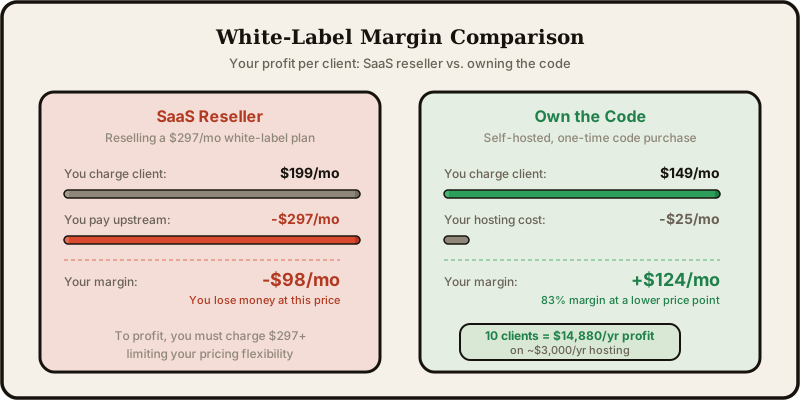
The math
One white-label client paying $149/month is $1,788/year. Your cost for that client is maybe $20-30/month in hosting resources. That's over 85% margin.
Get 10 clients at that rate and you're at $17,880/year in revenue on roughly $3,500 in costs. That's from a one-time investment in the source code and some setup time.
Compare that to reselling a SaaS platform where you're paying $97-297/month upstream per client and keeping the spread. At 10 clients on a $297 plan, you're paying $35,640/year to the platform before you even think about profit.
Common questions about white-label CRM
What is a white-label CRM?
A white-label CRM is a customer relationship management platform you rebrand and sell to your clients under your own brand. The versions that hold up long term ship with the source code, so you control the features, the pricing, and the roadmap without a per-seat fee going back to a SaaS parent.
What's the difference between a white-label CRM and a CRM reseller program?
A CRM reseller program lets you sell someone else's SaaS for a commission or a discount. A white-label CRM lets you brand the product as yours and set your own pricing. When you own the source code, you can also modify the software itself. Reseller programs share upside with the parent SaaS. Real white-label ownership does not.
Can I resell a white-label CRM under my own brand?
Yes if the license allows it. A commercial white-label license like Seedly CRM's lets you rebrand and sell without publishing your source changes. Open-source AGPLv3 projects require you to offer users the source of any modified version, hosting included. GPLv3 projects treat hosting differently and are usually resale-friendly.
How much can agencies charge for a white-label CRM?
The two most common shapes are a one-time setup fee of $500 to $2,000 plus $49 to $149 per month for hosting, or an all-inclusive monthly subscription of $99 to $299. Because your marginal cost per client is close to zero when you own the source code, the ceiling is set by the niche you serve, not the platform.
Which white-label CRM is best for agencies?
Agencies that want to own the code and never pay a per-client fee usually land on Seedly CRM at $1,499 one-time or a self-hosted open-source option like SuiteCRM or Twenty. Agencies that prefer a fully managed SaaS pay a monthly plan for SuiteDash, GoHighLevel, or Vendasta and give up code-level control in exchange.
Do I need to host the CRM myself?
With Seedly CRM you deploy the source you own to infrastructure you control. Convex Cloud handles the database and functions by default, and you can host the app portion on Vercel, Railway, or your own container. Open-source options like SuiteCRM and Mautic run on any Linux server.
The bottom line
Real white-labeling requires owning the code. Everything else is just reselling with a custom logo.
If you're coming from GoHighLevel and want to compare your options, I put together 5 GoHighLevel Alternatives Where You Actually Own the Code. And if you're wondering whether to build your own CRM or start from an existing codebase, read why forking beats building from scratch.
If you're ready to build a CRM business where you control every variable, start with source code, not a subscription. Before you onboard your first client, clean house with a data audit so your reports tell the truth from day one.
Rip everything apart and resell it for profit. I don't really care as long as it helps you move forward.