
The build vs. buy CRM debate usually ends one way. Months of wasted time. If you're thinking about how to build your own CRM, the better question is whether you should fork existing CRM source code instead of writing a custom CRM from zero.
Every engineering team and every agency owner I talk to thinks they're the exception. "Our needs are too unique for an off-the-shelf CRM." They almost never are.
I know because I've been on both sides. I've tried to build from scratch and I've forked an existing codebase. The math isn't even close.
I'm not a developer
Let me get this out of the way first. I'm not a developer. Never claimed to be. I'm a dude that's just generally pretty good at figuring stuff out when I get annoyed that other solutions don't work.
That distinction matters because if I can fork CRM source code and ship a production system without being a developer, the "build your own CRM from scratch" crowd is dramatically overcomplicating this.
Join the Seedly owners community.
Owners trade setups, share add-ons, and swap playbooks. See what people are building before you commit.
The build-from-scratch trap
Here's what actually happens when you decide to build your own CRM.
Week 1-4. You're excited. You scaffold the project, build the contact model, get basic CRUD working. This is fun.
Month 2-3. You realize you need auth, roles, permissions, audit logs, email integration, calendar sync, pipeline management, reporting, form builders, and 47 other things you didn't think about.
Month 4-6. You're debugging edge cases in your homegrown permission system instead of doing client work. The "3-month project" is now a 6-month project and you're maybe 30% done.
Month 7-9. You either abandon it or launch something half-baked that your team doesn't trust.
I've seen this pattern play out over and over. People think building a CRM is about contacts and deals. It's not. It's about the 200 other features that make those contacts and deals actually useful.
The fork path
Here's what I did instead.
I took an existing codebase, one that already had the hard stuff built (auth, permissions, multi-tenancy, pipeline management, email templates, workflow automation), and spent my time customizing it for my specific use case.
I have put well over 900 hours into slowly massaging the codebase for consistency, security, and functionality. I've also spent around $1,600 on Claude Code over that time.
900 hours is a lot. But if I had started from scratch, I'd have spent 2,000+ hours and still wouldn't have feature parity with what I started with. I break down the full cost math in What Your CRM Actually Costs Over 5 Years.
For you to get to the point I'm at right now, if your time is worth minimum wage, that would be over $13,000 worth of an investment on time alone. And I reverse 10x'd that for anyone who picks up the finished codebase.
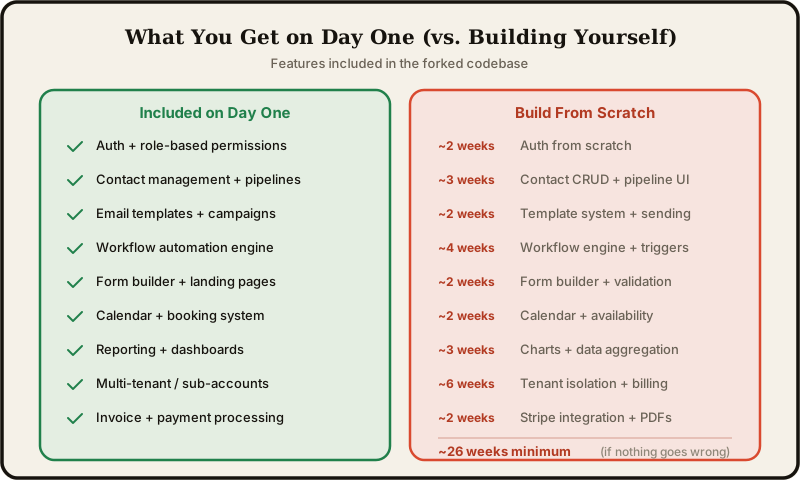
What you actually need vs. what you think you need
Most teams think they need these 5 features that no existing CRM provides:
- A custom field type that's slightly different from standard
- A specific workflow trigger that doesn't exist
- A reporting view that combines data in a unique way
- An integration with an internal tool
- A UI that matches their brand
All five of those are customization work on an existing codebase, not reasons to build from zero. When you own the source code, you can modify anything. You're not limited to what the API exposes or what the plugin system allows.
The 3 features you actually need that no SaaS provides
-
The ability to not get surprised on a Tuesday. When you own the code, updates happen when YOU deploy them. Nobody pushes a change that breaks your client flows while you're asleep.
-
Unlimited seats without per-user charges. Every SaaS CRM charges per seat. Hire a VA? That's $97/month. Bring on a contractor for a project? Another seat. When you own the code, seats cost $0.
-
The ability to resell or white-label without asking permission. Want to brand it as your own and offer it to clients? Go for it. Your styles, your fonts, your colors. Yours. I wrote a full guide on this. The White-Label CRM Playbook.
The honest case for building from scratch
I'll be fair. There is a case for building from scratch, but it's rare.
Build from scratch in these cases.
- You're building something that genuinely isn't a CRM (you need it to also be an ERP, a project management tool, and an inventory system in one)
- You have a full engineering team with 12+ months of runway and no clients waiting
- Your data model is so different from standard CRM patterns that modifying an existing schema would be harder than starting fresh
That's a real list, but it describes maybe 5% of the people who decide to build from scratch.
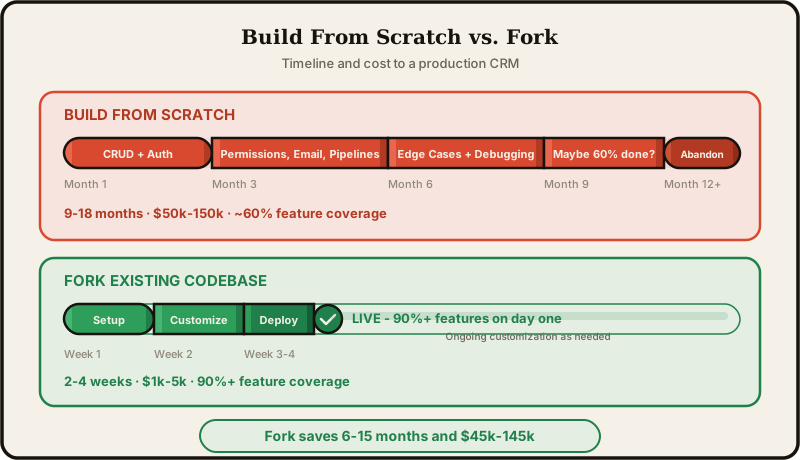
The cost comparison
Build from scratch
Fork existing code
You own itStay on SaaS
Fork existing code
You own it- Timeline
- 2-4 weeks setup, ongoing customization
- Total cost (at $50/hr)
- $1,000-5,000
- End result
- 90%+ features on day one
How to evaluate a codebase before forking
If you go the fork route, here's what to check.
- Is the code maintained? Check commit history. Active development means active bug fixes.
- What's the tech stack? Make sure it's something your team (or Claude Code) can work with.
- Is multi-tenancy built in? If you want to white-label, this is non-negotiable.
- How are permissions handled? Role-based access control should be in the foundation, not bolted on.
- What does the migration path look like? Can you import your existing data? How?
- What's the license? Make sure you can actually modify and deploy commercially.
The bottom line
It will cost less than the time and tokens it takes to build yourself. It will NOT have all the features you want out of the box. It will require some assembly and comfort with Claude Code or another coding tool. But it WILL allow you to truly build your own solution.
You'll be in control of feature updates. You'll be in control of what and how you charge. You'll get to plug anything into it that you want.
If you're coming from GoHighLevel specifically, I compared the alternatives in 5 GoHighLevel Alternatives Where You Actually Own the Code.
Once you've forked, the first thing worth setting up is referral tracking. It was my #1 growth channel and I had zero data on it for three years.
Stop building from scratch. Fork something good and make it yours.